
Nitish Rana’s Double Dismissal: Unraveling the Controversy in DC vs CSK
The world of cricket, while often predictable in its fundamental mechanics, occasionally throws up moments of such unique confusion that even seasoned commentators and fans are left scratching their heads. One such perplexing incident occurred during the high-stakes Indian Premier League (IPL) clash between the Delhi Capitals (DC) and Chennai Super Kings (CSK) on May 6. Nitish Rana, the Delhi Capitals’ batter, found himself at the centre of a rare ‘double dismissal’ situation that sparked significant debate and required a precise application of the laws of the game. The incident, captured and discussed widely across platforms like X and @CREX Instagram, highlighted the intricacies of cricket’s rulebook.
Delhi Capitals were already facing an uphill battle against the formidable CSK attack. With their innings struggling at 61 for 4 in the 9.3 overs, Rana’s dismissal only compounded their woes. However, it was the bizarre sequence of events leading to his exit that truly captured attention, creating a moment that will likely be replayed and discussed for seasons to come. Let us meticulously examine the details of this unusual dismissal and the rules that ultimately governed the decision.
How Nitish Rana’s Dismissal Unfolded in the DC vs CSK Clash
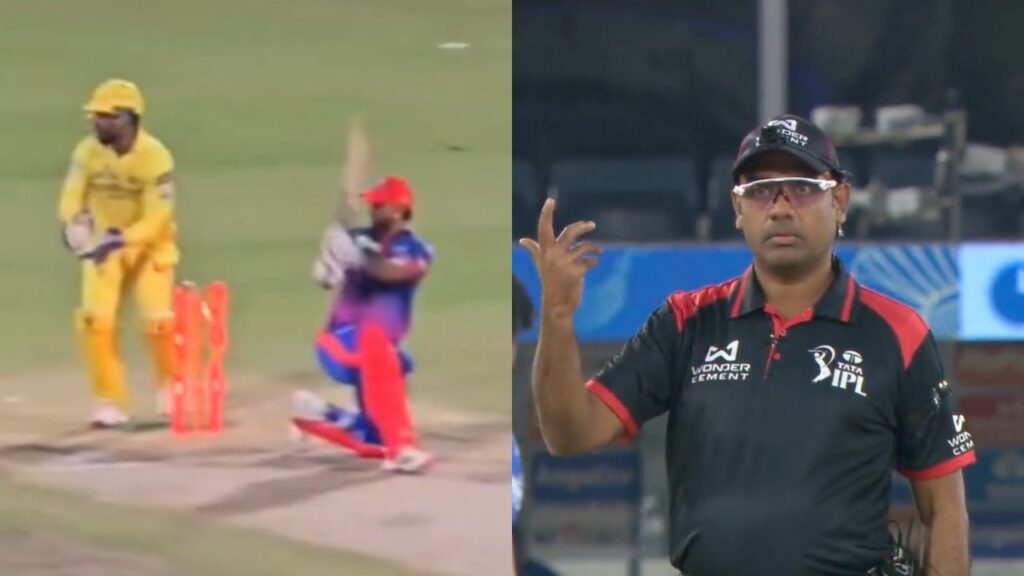
The crucial moment arrived on the third delivery of the 10th over, bowled by CSK’s Noor Ahmad. Nitish Rana, attempting to accelerate the scoring rate, played an aggressive sweep shot. The ball connected with his bat and soared high into the air, heading towards the boundary ropes. A fielder positioned strategically completed what appeared to be a regulation catch, bringing an end to Rana’s brief stay at the crease.
However, the apparent simplicity of the catch was immediately complicated by an extraordinary detail. Even before the fielder had secured the catch, multiple replays and various camera angles clearly showed that the bails on the stumps had fallen independently. This unexpected occurrence instantly raised questions about the validity of the dismissal. What made the situation even more puzzling was the undeniable evidence that neither the bowler, Noor Ahmad, nor the CSK wicketkeeper, Sanju Samson, had made any contact with the stumps. The bails seemed to have dislodged on their own, defying conventional explanations and introducing an element of mystery into the proceedings.
The Mystery of the Dislodged Bails: Wind’s Unseen Hand
The advanced Zing wicket system, equipped with low-voltage LED bails designed to light up instantaneously upon being dislodged, further highlighted the unusual nature of the incident. The immediate illumination of the bails confirmed their separation from the stumps, yet the absence of any player contact remained a central enigma. Investigations quickly pointed towards an external factor: the strong winds prevalent at the Arun Jaitley Stadium that day. These same windy conditions had earlier caused interruptions to play, hinting at their potential to influence the game in unforeseen ways. The preceding bad weather, characterized by heavy winds and intermittent rain before the match, had already created an environment ripe for such wind-related anomalies, adding a layer of meteorological drama to the cricketing contest.
Decoding the Rulebook: Was Rana Out or Not Out?
The unusual circumstances necessitated a clear interpretation of cricket’s extensive laws. The primary question was whether the bails falling due to external factors, such as wind, constituted a ‘broken wicket’ in the context of a potential dismissal. According to the International Cricket Council’s (ICC) playing conditions, if the bails fall due to external factors like wind while the ball is still in play, the wicket is not considered broken unless the dislodgement is directly caused by the ball itself or by a player. This distinction is absolutely crucial in such scenarios.
Therefore, in Nitish Rana’s case, since the bails were dislodged by the wind and not by Rana himself (which would constitute ‘hit wicket’) or by any fielder attempting a run-out or stumping, the act of the bails falling did not render the wicket ‘broken’ in a manner that would nullify other forms of dismissal. Consequently, the catch, which was cleanly taken by the fielder, stood as the legitimate mode of dismissal. Rana was declared out caught, despite the prior falling of the bails, because the wicket was not deemed to have been legitimately ‘broken’ by a player or the ball at that precise moment.
Furthermore, it is worth noting that under MCC Law 8.5, umpires possess the discretion to continue play even without bails in extreme weather conditions where their dislodgement becomes a persistent issue. While this specific provision was not invoked to remove the bails entirely, play continued with the same set, as a replacement was not deemed necessary despite the challenging windy conditions throughout the match.
It is important to consider a contrasting scenario: had Rana himself dislodged the bails (e.g., by making contact with them through his bat or body) before the catch was completed, he would have been ruled out ‘hit wicket’. In such a situation, the ball becomes ‘dead’ immediately upon the bails being legitimately dislodged by the batter, thereby negating any subsequent catch. This distinction underscores the nuanced nature of cricket’s laws and the importance of identifying the precise cause of a bail dislodgement.
Delhi Crumble as Chennai Super Kings Secure an Easy Win
Regardless of the controversy surrounding his dismissal, Nitish Rana’s departure marked a significant turning point in the Delhi Capitals’ innings. Already struggling, Rana’s wicket at a critical juncture intensified the pressure on the remaining batters. Skipper Axar Patel also failed to make an impact, departing for a mere 2 runs, leaving DC reeling further at a precarious 69 for 5 at the end of 11 overs. The middle order seemed to be in disarray, unable to forge meaningful partnerships against CSK’s disciplined bowling attack.
It was only through the determined efforts of Tristan Stubbs, who scored a resilient 38 runs off 31 balls, and Sameer Rizvi, who remained unbeaten with a crucial 40, that the Capitals managed to post a somewhat respectable total of 155 on the scoreboard. Their partnership provided a late surge, adding much-needed runs and preventing an even more comprehensive collapse. Despite their efforts, the total was ultimately deemed insufficient against a potent Chennai Super Kings batting lineup.
The target of 156 proved to be a comfortable chase for Chennai. Spearheaded by a magnificent unbeaten 87 from their captain, Sanju Samson, and a valuable 41 runs off 31 balls from Kartik Sharma, the ‘Yellow Army’ meticulously chased down the target inside 17.3 overs. Samson’s innings was a masterclass in controlled aggression, anchoring the chase with precision and power. The ease of the chase not only secured a crucial two points for Chennai but also provided a significant boost to their net run rate, which is often a critical factor in the latter stages of the IPL league phase. At the time of this match, Chennai Super Kings found themselves in the sixth position on the points table, making every victory and NRR improvement vitally important for their playoff aspirations.
The match, while largely dominated by CSK’s clinical performance, will be remembered for the rare and intriguing ‘double dismissal’ incident involving Nitish Rana. It served as a vivid reminder of cricket’s complex laws and the critical role of umpires in making informed decisions based on precise interpretation, even when faced with the whims of nature.