

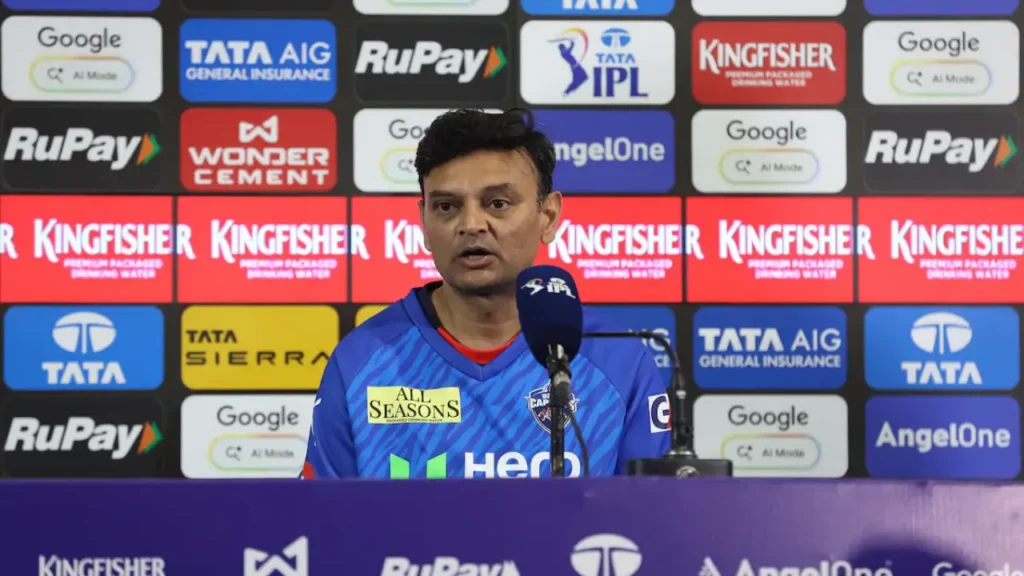
Delhi Capitals head coach Hemang Badani has made a bold and unprecedented claim about pitch control in the IPL, stating that the BCCI dictates the nature of playing surfaces at the Arun Jaitley Stadium—home ground for DC in IPL 2026. The revelation came after Delhi’s fourth consecutive home defeat, this time against the Chennai Super Kings, on a slow, spin-friendly track that heavily favored CSK’s bowling unit.
Home Turf, Foreign Conditions
On May 5, Delhi Capitals were once again left grappling with conditions that seemed anything but ideal for their batting-heavy lineup. Chasing a modest 157, CSK sealed the win with ease, thanks to an unbeaten 87 by Sanju Samson and a composed 41 by Kartik Sharma. But it was the pitch that dominated post-match discussions.
DC were reduced to 69/5 in the 11th over on a surface where spinners Akeal Hosein and Noor Ahmad stifled scoring. Fast bowlers Mukesh Choudhary and Gurjapneet Singh added pressure early, exploiting the sluggish bounce. Sameer Rizvi, introduced as the Impact Player, top-scored with 40, but it wasn’t enough to mask the team’s struggle on their so-called home ground.
A Pattern of Home Disadvantage
This loss marked DC’s fourth at home in five matches this season. The previous home game saw them collapse to a humiliating 75 all out against Royal Challengers Bengaluru—a match where they were reduced to 8/6 inside the PowerPlay. Just days before that, they had conceded 265 against Punjab Kings and still managed to lose, despite defending what should have been a winning total.
The inconsistency in pitch behavior has raised eyebrows. Was it a flat deck one week and a minefield the next? According to Badani, the franchise has no say in the matter.
“We Don’t Have Any Control”
During the post-match press conference, Badani dropped a bombshell:
“We don’t have any control over the surfaces. As much as one would like to think that we are in control of the surfaces we want to play on, there’s a clear mandate from the BCCI that they look after the pitches and they’re the ones who ensure that there’s no local side that gets benefits out of the surfaces. You play what is presented to you.”
This statement is the first of its kind in the 19-year history of the IPL. While pitch standardization has always been a BCCI goal, no other franchise official has publicly confirmed centralized control over home venue conditions. If true, it fundamentally alters the concept of ‘home advantage’—a strategic element teams often build their season around.
What This Means for Delhi Capitals
With DC sitting seventh on the points table—four wins in ten games—and facing a must-win clash against Kolkata Knight Riders on May 8, the lack of pitch control could not come at a worse time. Ironically, KKR enter the game on a three-match winning streak, despite being one spot below Delhi.
Without the ability to tailor conditions to suit their key players—especially their pace-heavy bowling attack—Delhi may continue to find themselves at a disadvantage, even on home soil.
A League-Wide Conversation?
Badani’s comments could spark a broader debate. If the BCCI is indeed standardizing pitches to eliminate home bias, it should be transparent across all franchises. Yet, no other team has echoed this sentiment. Are DC being singled out? Or is this a quiet policy applied league-wide?
Cricket analysts and fans alike are now questioning whether the move, while fair in principle, undermines the strategic planning of franchises. Teams invest heavily in player acquisition based on expected home conditions—only to face surfaces they didn’t anticipate.
As the IPL 2026 season enters its business end, one thing is clear: for Delhi Capitals, the battle isn’t just against the opposition. It’s also against the very ground they’re supposed to own.