

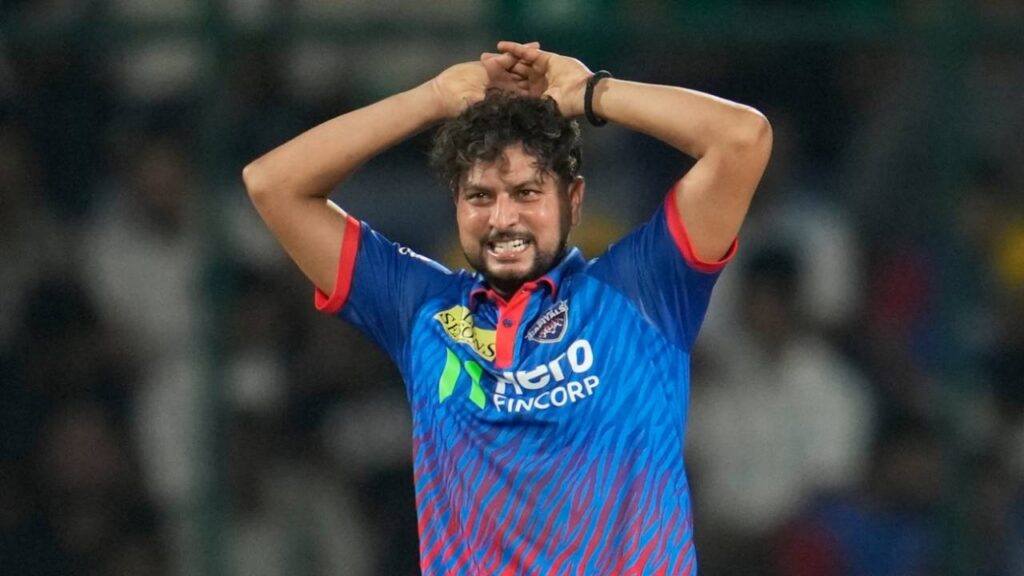
The Growing Concern: Kuldeep Yadav‘s Season of Struggle
In the high-stakes environment of the IPL, a team’s success often hinges on the performance of its core specialists. For the Delhi Capitals (DC) in the 2026 season, that core is currently under immense pressure. Among the many issues plaguing the franchise, the form of Kuldeep Yadav has transitioned from a minor talking point to a glaring crisis. The left-arm wrist-spinner, usually a reliable wicket-taking threat, has found himself at the receiving end of some brutal hitting, and the frustration within the camp is beginning to boil over.
Following DC’s recent loss to the Kolkata Knight Riders (KKR), the mood in the dressing room was somber. Venugopal Rao, DC’s Director of Cricket, did not mince words during the post-match press conference. “We are facing that failure,” Rao admitted, acknowledging the team’s seventh loss of the season against just four wins. The spotlight, inevitably, fell on Kuldeep’s figures: zero wickets for 41 runs in just three overs.
By the Numbers: A Statistical Nightmare
To understand the depth of Kuldeep’s struggles, one must look at the cold, hard data. Across 11 appearances this season—having played every single game for DC—Kuldeep has managed to claim only seven wickets. For a bowler of his pedigree, an average of 50.28 is nearly unthinkable. However, it is the economy rate that is truly damaging the Capitals’ prospects. Currently standing at 10.66, Kuldeep is among the most expensive bowlers in the tournament.
In fact, when looking at bowlers who have delivered at least 30 overs in IPL 2026, only T Natarajan—who predominantly bowls the difficult death overs—has a higher economy rate (11.18) than Kuldeep. For a middle-overs specialist whose primary role is to squeeze the opposition and provide breakthroughs, these numbers are a statistical red flag.
Tactical Breakdown: Lengths and Lines Under Fire
The match against KKR served as a microcosm of Kuldeep’s season. He was hit for at least two boundaries in each of his three overs, including five massive sixes. The distribution of those hits tells a story of inconsistent lengths. Four of those sixes were dispatched by Finn Allen, while Cameron Green added another to the tally. The deliveries were either too short or too full, leaving the batters with easy choices in the hitting arc.
Cricket analyst Deep Dasgupta offered a piercing critique of Kuldeep’s current approach. Speaking on ESPNcricinfo’s TimeOut, Dasgupta noted that Kuldeep is being hit square of the wicket far too often. “My thing with Kuldeep is that you can’t be hit for six over square leg off a short ball, and over long-off and long-on [as well],” Dasgupta explained. He argued that while getting hit is part of the T20 format, the direction of the hits matters. “I’d rather have him be hit over mid-off and mid-on—down the ground—rather than square of the wicket or extra cover.”
The data supports this concern regarding his fuller deliveries. This season, Kuldeep has bowled 70 full-length deliveries, conceding 178 runs at a staggering strike rate of 254.28. To put that in perspective, his strike rate against full balls was 168.88 in 2024 and a modest 133.65 last season. He has only managed two wickets from full deliveries this year, suggesting that even when he tries to attack, he is missing his mark.
Expert Analysis: The McClenaghan Perspective
Former New Zealander Mitchell McClenaghan also weighed in on the technical failures. According to McClenaghan, Kuldeep’s line has been just as problematic as his length. He observed that too many deliveries were landing in the “hand-freeing arc” between the fourth and eighth stumps.
- Lack of Pressure: Balls were not consistently hitting the top of the stumps.
- Predictability: The lack of variety in wide lines allowed batters to stay stationary and swing through the line.
- The Missing Edge: McClenaghan emphasized the need to “play the corners of the base,” a strategy Kuldeep has failed to implement effectively this season.
The Impact on the Bowling Partnership
The ripple effect of Kuldeep’s form is felt most acutely by his spin partner and captain, Axar Patel. Traditionally, the duo has operated in tandem to choke opposition scoring rates in the middle overs. When one is struggling, the pressure shifts entirely to the other. After a previous game against Chennai Super Kings (CSK) where Kuldeep went for over 11 an over, Axar lamented, “When we were bowling, I missed my partner Kuldeep.”
This sentiment was echoed by Venugopal Rao, who noted that a bowling group thrives on collective consistency. “One is doing well, one is not, it hurts in a bowling group,” Rao stated. While the team remains supportive of Kuldeep, the reality of the points table means that the time for patience is running out.
Conclusion: Can Kuldeep Turn it Around?
For Delhi Capitals to have any hope of a late-season resurgence, they need the vintage Kuldeep Yadav to return—the one who bowls with guile, finds the right lengths, and forces batters to play down the ground rather than across the line. As it stands, the “worry lines” at DC are only deepening. Unless the technical adjustments regarding his fuller deliveries and stump-to-stump lines are addressed immediately, the 2026 season may well be remembered as a missed opportunity for both the bowler and his franchise.