

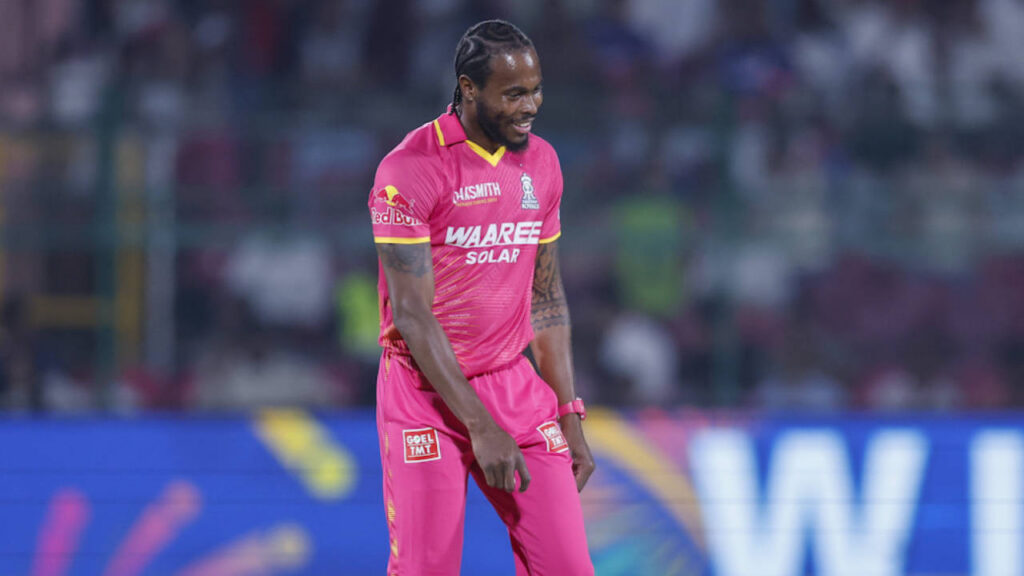
The Rajasthan Royals (RR) are experiencing a perplexing turn of fortunes in the IPL 2026 season, showcasing a stark contrast between their away and home performances. While they celebrated three consecutive victories in Guwahati, their designated second home, their return to Jaipur has been met with three successive losses. This perplexing pattern suggests that their traditional home advantage in the Pink City is, for now, a distant memory, raising serious questions about their current form and strategic approach.
Cricket pundit Deep Dasgupta attributes RR’s recent struggles simply to “not playing good cricket.” Speaking on ESPNcricinfo TimeOut, Dasgupta dismissed other potential factors, stating, “I think they haven’t really played good cricket there [in Jaipur], and I think that’s the only reason. I can’t think of anything else.” He highlighted Jaipur’s reputation as a high-scoring venue and pointed to RR’s persistent batting issues. Last year, the team was heavily reliant on its top order, a vulnerability that appears to have resurfaced this season. The middle order continues to be a point of concern, with young talent Dhruv Jurel enduring an inconsistent season. Dasgupta’s assessment underscores a fundamental need for the team to uplift its overall game, especially when playing on familiar turf.
Jofra Archer’s Form and Pitch Conditions
Adding another layer to RR’s challenges is the form of their premier fast bowler, Jofra Archer. Former quick Mitchell McClenaghan believes that Archer, often regarded as RR’s “main weapon at the top,” is not receiving the requisite assistance from the Jaipur pitches. McClenaghan observed a noticeable absence of the “lift and bounce” that characterized Archer’s devastating spells at their previous home ground, where he was once “ripping people’s heads off.” Prior to their current struggles, Archer had been a consistent wicket-taker, often demonstrating crucial lateral movement with the ball. However, current conditions in Jaipur are evidently “not conducive for genuine swing or lateral movement,” directly impacting his effectiveness.
Archer’s performance had indeed been formidable earlier in the season. Between April 7 and May 1, he consistently picked up at least one wicket in eight consecutive games, even securing two wickets in the first match in Jaipur. However, since then, his figures have dipped significantly, with returns of 1 for 46 and 0 for 46 in subsequent outings. This stark decline coincides with the team’s overall slump, reinforcing the notion that pitch conditions and Archer’s ability to exploit them are intrinsically linked to RR’s success.
A Costly Over: Archer’s Struggle Against Gujarat Titans
The extent of Archer’s current struggle was starkly visible in his first over against Gujarat Titans (GT) on a recent Saturday evening, an over that proved to be both puzzling and expensive. After RR opted to bowl first, Archer was tasked with opening the attack but required an astonishing 11 deliveries to complete his first over. The third ball, in particular, became a prolonged ordeal, consuming five deliveries due to a no-ball, followed by five wides down the leg side, and then two more wides before a legal delivery could finally be bowled. This chaotic start gifted GT an alarming 18 runs from the very first over.
McClenaghan, reflecting on this over, humorously remarked, “Oh, I got tired just watching it. Some endurance to get through that.” He acknowledged that such a start was “not what they needed,” especially with only half of those runs coming off the bat. McClenaghan pointed to Archer’s “radar” being off, a common occurrence for players returning from a break – RR had played after an eight-day gap – leading to a loss of rhythm. The consensus was clear: Archer’s bowling lacked its usual crispness and precision, contributing significantly to the team’s early troubles in that particular match.
Shane Bond Demands Innovation from Bowlers
The frustration within the Rajasthan Royals camp is palpable, perhaps most acutely felt by bowling coach Shane Bond. Following the game against GT, Bond’s comments at the press conference reflected a deep sense of disappointment. His exasperation is entirely understandable, given that RR has now conceded well over 200 runs in four consecutive matches, managing to win only one of them. This defensive collapse is a major factor in their recent downturn.
“We just haven’t played well enough in conditions that we know. We’ve been outplayed by our opposition,” Bond stated, articulating the team’s current predicament. His primary focus, however, was on the bowling unit. “I look at bowlers, they just have to be better, right? You’ve got to think a bit outside the box.” Bond broke down the issue into two critical components: decision-making and execution. He observed that execution had been consistently poor for far too long, a trend he believes is prevalent across the IPL.
Adapting to Aggressive Batting Trends
Bond emphasized that modern T20 cricket demands a fundamental shift in mindset from bowlers, especially with batsmen adopting increasingly aggressive tactics. “The batsmen, they’re coming out, they’re playing ultra-aggressive, and putting pressure on bowlers,” he explained. This aggressive approach necessitates a reciprocal evolution from the bowling side. Bond posed a crucial question to his bowlers: “‘what can I do differently?'”
He urged them to invest more time with analysts, meticulously studying each batsman’s scoring zones and preferred areas. Furthermore, he advocated for greater versatility in their approach, suggesting bowlers should be able to “bowl off a shorter run and a longer run” and “come around the wicket and bowl on both sides.” The underlying message was clear: repetitive tactics yielding poor results are unacceptable. “So, when you see the bowlers are doing the same thing, game after game after game after game, getting the same result, then my question would be: you’ve got to be doing something different and developing your game,” Bond asserted.
Drawing a parallel with batsmen, who have developed an expansive repertoire of shots – from the uppercut to the reverse sweep and scoop – Bond argued that bowlers must also develop their “range of skills.” He views this challenge not as a burden, but as a significant opportunity. “I think it’s a great opportunity for any bowler to go: ‘if I can do that, then I can elevate myself into, you know, a lot of money and be a superstar’.” Bond lamented the lack of consistent innovation across the league, suggesting that too many bowlers are stuck in a rut.
He acknowledged the inherent difficulty for bowlers in the current high-scoring environment but presented a clear dichotomy: “It’s certainly not easy for the bowlers, but you can either fear it, fear what’s going on out there, or see it as an opportunity to get better and maybe put your name up in lights.” This call to action is a stern warning and an encouragement for his bowlers to embrace adaptability and strategic thinking.
Playoff Qualification: A Looming Concern
The sequence of recent losses has had a significant impact on Rajasthan Royals’ standing in IPL 2026. After an impressive start that saw them near the top of the league table, they have now slipped down to the No. 5 position with only three league-stage matches remaining. While qualification for the playoffs is still within reach, the drying up of victories is a major cause for concern. The team’s current trajectory raises uncomfortable parallels with their 2025 season, and avoiding a similar disappointing conclusion will require an immediate and decisive turnaround in both performance and strategy.