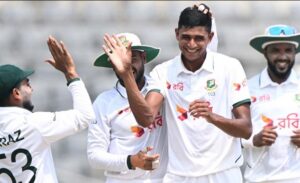

Bangladesh national team spinner Nasum Ahmed has once again brought to light the persistent issue of unpaid dues in franchise cricket, directly accusing the Sylhet Titans of withholding a significant portion of his payment from the previous season of the Bangladesh Premier League (BPL). The left-arm spinner’s frustration has reached a boiling point, leading him to take his grievances public in a dramatic appeal that has reverberated across the cricketing fraternity.
The Genesis of the Dispute: Last BPL Season
The core of the dispute dates back to the most recent edition of the Bangladesh Premier League, where Nasum Ahmed claims he did not receive his full remuneration from the Sylhet Titans. This is not the first time such an allegation has surfaced. Following the initial complaints, the Titans franchise issued a statement attempting to shift blame onto Nasum, asserting that he was responsible for the delay in encashing a cheque. This explanation, however, appears to have done little to resolve the underlying issue or satisfy the disgruntled player.
The Bangladesh Premier League, a cornerstone of the nation’s cricketing calendar, is vital for both established stars and emerging talents. It provides a crucial platform for players to showcase their skills, earn their livelihoods, and contribute to the sport’s development in the country. When financial commitments are not honoured, it not only impacts the individual player but also casts a shadow over the league’s reputation and financial stability, potentially deterring future investments and talent.
Nasum Ahmed’s Public Outcry: A Direct Challenge
In a bold move, Nasum Ahmed escalated the matter by sharing videos and voice recordings on his Facebook profile, explicitly demanding his remaining payment. His post was not merely a complaint but a direct and emotionally charged challenge to the franchise, particularly its leadership. The language used by Nasum underscores a deep sense of betrayal and exasperation, highlighting the personal toll such financial disputes take on athletes.
Addressing the franchise, Nasum wrote, “Hello Titans. You have paid me 3.5 million taka, but will you pay the remaining 3.5 million from my direct contract? Or will you pay it after I die, during my funeral rites? If you do, please let me know so I can inform my family that Sylhet team owner Mahidul Islam Sami will pay my money after I’m gone.” This poignant and somewhat sarcastic statement reflects a desperate plea for justice, emphasizing the perceived indifference of the franchise towards its players’ financial security. The direct mention of Mahidul Islam Sami, the team owner, indicates Nasum’s intention to hold specific individuals accountable for the outstanding dues.
A Personal Appeal to the Advisor
Beyond his confrontational message to the ownership, Nasum Ahmed also extended a more personal appeal to Fahim Al Chowdhury, an advisor to the Sylhet Titans. This nuanced approach demonstrates Nasum’s attempt to exhaust all possible avenues for resolution, seeking intervention from someone he perceives as an elder figure and from his local area.
Nasum’s message to Chowdhury stated: “Brother Fahim, I respect you. I know you are busy. When you get some time, please listen to the voice recordings – what I said about you and what they said to me. I don’t have anything to ask from you personally. You are from our area, like an elder brother who built a team. That’s why I’m reaching out. Please help me get my money. I don’t really have anyone else to speak for me. Thankfully, I got your number and could speak to you briefly. I know you didn’t have much time, but I appreciate those two minutes.” This segment reveals the intricate dynamics often at play in local sports, where personal relationships and community ties can sometimes be leveraged in times of crisis. It also paints a picture of Nasum feeling isolated and seeking assistance from any available quarter.
Performance on the Field vs. Payment Off It
Crucially, Nasum Ahmed also took the opportunity to remind everyone, especially the Sylhet Titans management, of his invaluable contributions and stellar performance during the very tournament for which he is now seeking payment. His statistics from the last BPL season are indeed impressive and serve as a powerful counterpoint to any argument that his claims are unwarranted.
He highlighted: “In the last BPL, I played 12 matches and took 18 wickets with an economy of 5.97. I was the second-highest wicket-taker, and my best bowling was 5 for 7.” These figures underscore his role as a key performer and one of the league’s most effective bowlers. For a player who delivered such consistent and high-impact performances to be struggling to receive his rightful earnings raises serious questions about the professional ethics and operational standards of the franchise and, by extension, the league itself.
- Matches Played: 12
- Wickets Taken: 18
- Economy Rate: 5.97
- Best Bowling Figures: 5 wickets for 7 runs
- Overall Ranking: Second-highest wicket-taker in the tournament
Such statistics are not merely numbers; they represent dedication, skill, and a tangible contribution to the team’s efforts. The argument is clear: if a player performs at an elite level, their contractual obligations should be met without delay or dispute.
Broader Implications for Player Welfare and Franchise Cricket
Nasum Ahmed’s situation is unfortunately not unique in the world of professional sports, particularly in franchise leagues where financial irregularities can sometimes emerge. Such incidents have far-reaching implications:
- Player Morale and Trust: Unpaid dues severely impact a player’s morale, trust in the system, and financial stability. It can lead to psychological stress and distract from their primary role of performing on the field.
- League Reputation: Repeated instances of payment defaults tarnish the reputation of the BPL and similar leagues, making them less attractive to top international talent and potential sponsors.
- Financial Transparency: These disputes highlight the need for greater financial transparency and more robust regulatory mechanisms to protect players’ interests.
- Future Engagements: Players may become hesitant to sign with franchises known for payment issues, potentially leading to a decline in competitive standards.
The call for payment by Nasum Ahmed is more than an individual plea; it is a significant reminder of the responsibilities that come with owning and operating a professional sports franchise. Ensuring timely and complete payments is fundamental to maintaining the integrity of the sport and fostering a healthy ecosystem for athletes. The cricketing world will undoubtedly be watching closely to see how the Sylhet Titans respond to this renewed public challenge and whether Nasum Ahmed finally receives the remuneration he earned through his exceptional performance on the field.