
The Unfolding Pace Controversy
Shaheen Shah Afridi, once heralded as the spearhead of Pakistan’s pace attack, has recently found himself at the center of a heated debate regarding his physical conditioning and bowling velocity. During the first Test match against Bangladesh at the Sher-e-Bangla Stadium in Mirpur, the spotlight shifted from the scoreboard to the speed gun, as former PCB chief and commentator Ramiz Raja openly questioned the pacer’s intensity.
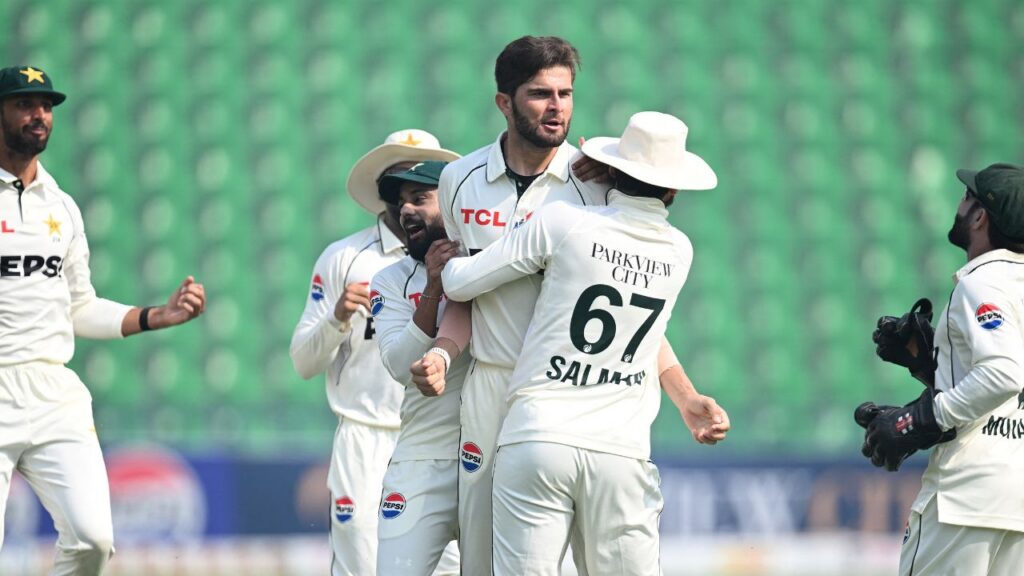
As the match commenced on May 8, with Pakistan opting to bowl first in the absence of Babar Azam, the team relied on a pace trio consisting of Afridi, Mohammad Abbas, and Hasan Ali. While Afridi successfully claimed the wicket of Mahmudul Hasan Joy early on, his subsequent spells raised eyebrows. Operating consistently between 130-135 kph, he lacked the menacing zip that once characterized his bowling.
Ramiz Raja’s Cutting Commentary
The critique from the commentary box was direct and unflinching. Observing the struggle to maintain a high speed, Ramiz Raja remarked, “We don’t have pacers like Nahid Rana. We have medium pacers. Shaheen Afridi so far has looked like a medium pacer.”
This comment highlights a growing trend that has become impossible for fans and pundits to ignore. While Afridi has publicly downplayed the impact of his 2022 knee injury on his bowling rhythm, the statistical evidence suggests a different story. The transition from a fiery fast bowler capable of consistently hitting the 140 kph mark to one struggling to maintain mid-130s speed is a shift that has profound implications for Pakistan’s Test ambitions.
Statistical Evidence of a Slowdown
The decline in speed is not merely a subjective observation but a measurable trend backed by data, particularly in the ODI format. In 2021, a remarkable 35% of Afridi’s deliveries clocked in at over 140 kph. Following his injury in 2022, that figure plummeted to 11%. Subsequent years have shown no significant recovery, with the percentages standing at 8% in 2023, 4% in 2024, and 9% in 2025.
This downward trajectory is replicated across the Test and T20I formats. While Afridi remains a threat with the new ball, his subsequent spells have often lacked the bite required to trouble set batsmen on flat tracks. For a team that relies heavily on its left-arm spearhead to provide early breakthroughs and maintain pressure, this shift is a source of genuine concern.
Broader Implications for Pakistan Cricket
Pakistan’s reliance on Shaheen Afridi is twofold: he is expected to be both the wicket-taker and the enforcer. When he operates below his potential, the pressure inevitably shifts to the rest of the bowling unit. As the squad navigates the current World Test Championship cycle, managing Afridi’s fitness and speed will be a tactical necessity rather than a luxury.
While panic is unnecessary, complacency could be detrimental. The coaching staff and medical team face the challenge of determining whether this drop in pace is a permanent fixture of his post-injury biomechanics or a temporary dip that can be corrected through specialized training and load management.
Match Context: Bangladesh Holds Firm
On the field in Mirpur, the narrative was equally challenging for the visitors. Despite early strikes by Afridi and Hasan Ali, which left Bangladesh at 31/2, the hosts demonstrated significant resilience. A composed partnership between Mominul Haque and captain Najmul Shanto steered Bangladesh to 101/2 after 26 overs, effectively negating the early pressure applied by the Pakistani seamers.
This Test match holds significant weight, serving as the first meeting between the two sides in the ongoing WTC cycle. With Bangladesh riding the momentum of their historic 2-0 series sweep against Pakistan in 2024, the visitors are under immense pressure to prove that their pace battery—led by an under-the-microscope Afridi—can still dictate terms on the international stage. As the series progresses, all eyes will remain on the speed gun whenever Shaheen Afridi marks his run-up.