
Shakib Al Hasan Breaks Silence: Reaffirms Political Loyalty Amidst Tumultuous Period
In an exclusive and long-awaited interview with bdnews24.com, star all-rounder Shakib Al Hasan has finally addressed the pressing political developments in Bangladesh, his prolonged absence from the country, and the various allegations he faces. It has been nearly two years since the cricketing icon last set foot in Bangladesh, following the dramatic fall of the government on August 5, 2024. This period has seen several cases filed against him, including a murder charge, further complicating his return. Since his participation in the Kanpur Test during Bangladesh’s tour of India in 2024, Shakib has not had the opportunity to represent his national side on the field, leaving fans and the public eager for his perspective on these challenging times.
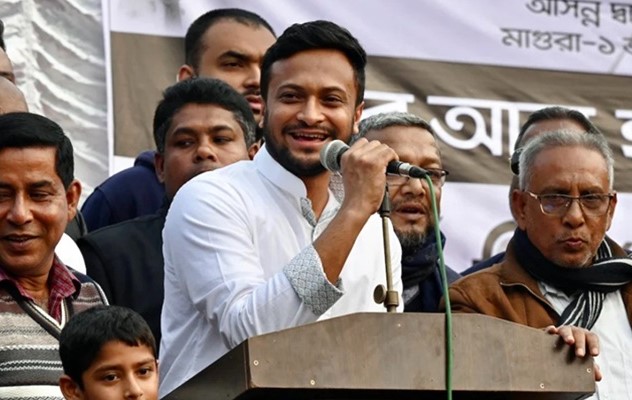
Shakib’s foray into politics began while he was still actively playing cricket at the international level. He successfully contested the election as a candidate for the Awami League, securing the Member of Parliament position from the Magura-1 constituency. However, this political tenure proved to be short-lived, as he lost his parliamentary seat just seven months after being elected, marking a significant shift in his public life.
Understanding the July Movement from Afar
During the interview, Shakib shed light on his understanding of the July movement, explaining the circumstances that kept him distant from the unfolding events. “First of all, before the 2024 T20 World Cup, I went to the United States,” Shakib recounted. “I returned briefly for two or three days in between. Then I played Major League Cricket in the US, and later Global T20 in Canada. I was away from the country for a long time, almost on the opposite side of the world. Naturally, I received news later than others. I was busy with cricket and did not know everything in detail.”
He further elaborated on the communication challenges during that critical period. “At one point, the internet was completely shut down,” he stated. “So, I was not fully updated. Yes, I heard there were protests, people were dying, and curfews had been imposed. But Bangladesh has seen many movements before. Since I was not following it deeply, I did not realize how serious it was.” Shakib expressed a sentiment of regret, suggesting that his physical presence might have altered his understanding. “Maybe if I had been in the country, I could have understood the depth of the situation better, and it would have been easier for me to take a stand,” he mused, highlighting the difficulty of comprehending a complex situation from a remote location.
Navigating Public Expectation and Controversy
Shakib also addressed the public’s expectation for him to make a statement or post on social media during the crisis. “I know many people expected me to post something on Facebook. Of course, many people would have seen it. But would it really have changed the situation? Even the government asked me to post something, but not in support of them. They suggested a message about finding a peaceful solution, similar to what many cricketers posted. But would that have made a major difference? I don’t know,” he questioned, reflecting on the efficacy of such actions.
Emphasizing the sanctity of life, Shakib delivered a poignant message. “I always say every life is valuable. When one person dies in a family, it is very hard for others to understand that pain. Every human life matters. Even today, when children die, it is heartbreaking. Every life matters,” he stated. He extended this sentiment to all who perished during the unrest: “Those protesters who died, the police officers who died, whoever died in whatever situation – every life matters.”
The period also saw his wife’s Instagram post ignite considerable debate and criticism. Shakib addressed this, asserting it was part of a broader attempt to tarnish his image. “That period showed how people were trying to build a negative image of me. During those few days, negative stories about me were spread in a way I had never seen before,” he explained. He clarified the context of the contentious photograph: “We were in Canada. Nobody knows if the photo was taken that day, the day before, or posted later. But when something is presented dramatically, people judge without thinking deeply. Some people tried to use that negatively because I was seen as part of the government.”
Another incident involved a viral video where someone from the stands challenged him, asking, ‘What have you done for the country?’ Shakib viewed this as a deliberate act. “That incident made things even clearer. One person was shouting, another was filming. It looked planned,” he observed. He expressed his dismay at the nature of the question: “A man who has represented the national team for 15 or 16 years is being asked what he has done for the country. Is that normal?” He underscored his contributions to the nation through cricket, contrasting it with social media pronouncements. “What is bigger? Posting a Facebook status or serving the country for 15-16 years on the field? I never said or wrote anything against the movement either,” he firmly stated.
Unyielding Political Loyalty and Vision for Democracy
When questioned about his future in politics, Shakib reiterated his current focus. “I said in an earlier interview that there is a lifetime ahead for politics. Right now, I am focusing on cricket,” he affirmed, indicating his priority remains on his cricketing career for the foreseeable future.
Crucially, when asked if the Awami League remains his political party, Shakib offered an unequivocal declaration of loyalty. “That is what it should be, right? I have no habit or desire to keep changing sides. I never did that in my life. If I joined any team, even a small one, I stayed loyal to it. I do not have the habit of switching sides,” he responded, emphasizing his steadfast commitment to the party he chose to represent.
He defended his political affiliation, asserting the fundamental right of individuals to support a party of their choice. “Why, is supporting a political party something wrong? Anyone can choose any party. Those who say one party is bad today, tomorrow their party may also be criticized when their time comes,” he posited, advocating for a more tolerant political discourse. Shakib further reflected on his personal philosophy: “I never believed in bringing others down. Even in cricket, I never thought someone failing would create my chance. I always believed if someone does well, I should do even better.”
Addressing the notion of restrictions on Awami League politics, Shakib voiced a strong belief in democratic principles. “It may be banned now, but will it stay banned forever? Can anyone keep others banned forever? This is people’s democratic right. You cannot suppress a large section of the country forever. Maybe for some time through force, but it does not help the country or politics,” he argued, highlighting the unsustainability of political suppression.
He called for an end to cyclical political mistakes and for genuine democratic competition. “If mistakes were made in the past, and now the same mistakes are repeated, then the cycle will continue. Someone has to end this cycle. The party that ends it will earn respect from the people. Everyone should get a fair chance to compete with their ideas. Then people can vote for whoever they prefer,” Shakib asserted, advocating for a fair and inclusive political landscape where the populace has the ultimate say.
“The people will judge that, not you or me,” Shakib concluded on the matter of political judgment. “The real way for people to judge is through voting. Let them vote for the party they like. Keeping a large section out of elections means taking away people’s right to choose.”
Interactions Abroad: A Different Political Climate
Finally, Shakib clarified his interactions with leaders from various political groups in New York City, which had also sparked discussion. “Brother, in New York I mix with many people from different parties. There are senior BNP leaders too. Politics here is not like Bangladesh. People from different parties meet, do business together, attend community events together, and even non-political people join. That is completely normal here,” he explained, distinguishing the political culture in the USA from that of Bangladesh, where such cross-party interactions might be viewed differently.