
[CRK]
The Future of T20 Batting is Here
Imagine T20 cricket in the year 2030. The IPL season stretches across six months, teams utilize four substitutions per match, and games frequently conclude in the early hours of the morning. In this futuristic landscape, the team’s most explosive hitter is tasked with batting through the entire 20-over innings. Abhishek Sharma is already playing that role.
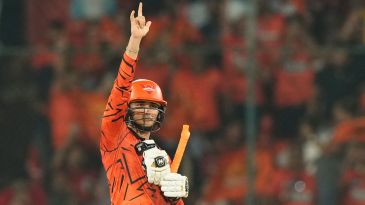
During his recent outing against the Delhi Capitals, Sharma looked as though he had traveled back in time from the future. He faced the very first ball of the innings and remained there until the very last. While this tactical compromise likely cost him about 30 runs in potential output, the result was still staggering: an unbeaten 135 off 68 balls. This mark stands as the fifth-highest individual score in the history of the IPL.
Throughout the carnage, Sharma remained the picture of composure, wearing his familiar chain tucked under his jersey and a poker face that betrayed nothing of the storm he was unleashing on the bowlers.
The Tale of Two Centuries: Power vs. Patience
To appreciate the evolution of Sharma’s game, we have to look back at his previous benchmark. Last season, he breached the elite list of high scores with a scarcely believable 141 off just 55 balls against the Punjab Kings. In that instance, his strike rate was a blistering 256.36—nearly 58 points higher than his rate in the match against DC.
The context was vastly different. Against PBKS, Sunrisers Hyderabad (SRH) were chasing a massive 246. Against DC, they were setting the total, eventually reaching 242. This shift in objective led to a fundamental question: Why did Abhishek bat objectively slower than his maximum capacity, especially at his home ground in Hyderabad, a known paradise for power-hitters?
A New Tactical Template
The answer lies in a combination of conditions and coaching. Speaking after the match, Sharma noted, “The way we started, we had a plan, we wanted to use the powerplay. But the wicket was a bit slow so we had to re-plan… you don’t know what a par score is.”
Beyond the pitch, there was a specific mandate from assistant coach James Franklin. Sharma revealed, “Franky wanted me to bat till the 20th over… This is the first time I’ve batted till the 20th over [in the IPL].”
Usually, Sharma’s philosophy is “a good time, not a long time.” When opening for India, he can afford to smash 40 runs off a dozen balls and exit, knowing an all-star lineup of Hardik Pandya, Suryakumar Yadav, and Shivam Dube can carry the momentum. However, the SRH middle order—featuring promising but less consistent names like Salil Arora, Aniket Verma, and Nitish Kumar Reddy—requires more stability at the top.
Even SRH’s powerhouse, Heinrich Klaasen, has adjusted his approach, paring his strike rate from 172.69 last year to 153.11 to ensure he holds the back half of the innings together. Sharma is now following that blueprint.
The Science of Control
The difference between “lucky” hitting and “controlled” dominance is found in the data. In his wild 141 against PBKS, Sharma’s control percentage was 66%. He survived wild slashes and dropped catches—a high-risk, high-reward strategy.
In the match against DC, that control percentage hovered over 90% for most of the innings, settling at a respectable 85% during the death overs. How did he achieve this? By stripping his game down to his greatest strength: hitting sixes.
Despite facing 13 more balls against DC than he did in the PBKS knock, he hit four fewer fours. For a batter of Sharma’s profile, a four is often a higher risk than a six; any ball that lands inside the boundary involves fielders and precise placement. By focusing on clearing the ropes—specifically playing in the ‘V’ with a straight blade—he minimized the risk of a mistake.
Joining the Elite
By adapting his game to the conditions and the team’s needs, Abhishek Sharma has mirrored the greatness of Virat Kohli. Kohli is the master of holding back his ceiling to ensure he bats through an innings when the situation demands it. In doing so, Sharma has equalled Kohli’s record for the most T20 centuries by an Indian (nine).
As a bonus, this performance propelled him past Klaasen to the top of the Orange Cap leaderboard. While the burden of being the primary run-scorer can be heavy, Sharma seemed unfazed. As he slipped on the Orange Cap for the cameras with a wide smile, it became clear: the pressure doesn’t feel so heavy when you’re playing a game from the future.