

[CRK]
A Tale of Two Halves: The Promising Start and the Sudden Stagnation
Cricket is often a game of momentum, and for a significant portion of the first ODI against New Zealand in Dhaka, Bangladesh seemed to have all the momentum in their favor. Chasing a target that felt well within reach, the Tigers were cruising at 114 for 2 in the 23rd over, putting them in a commanding position to secure a routine victory at the Shere Bangla Stadium.
The foundation was laid by a disciplined and productive partnership between Saif Hassan and Litton Das. The duo added 93 runs for the third wicket, providing the stability and acceleration required in the early stages of a chase. Saif Hassan, showing great composure, reached his second ODI half-century, while Litton Das looked threatening with a score of 46. However, Litton’s innings ended in a frustratingly familiar pattern; this marked his third consecutive dismissal in the 40s, a trend that continues to haunt his ability to convert starts into match-winning hundreds.
The Middle-Overs Muck-Up: Where it All Went Wrong
The turning point of the match arrived in the space of just five overs. New Zealand’s bowling attack managed to dismantle the set duo, sending both Saif and Litton back to the pavilion and triggering a period of extreme stagnation. What followed was not a collapse of wickets, but a collapse of intent.
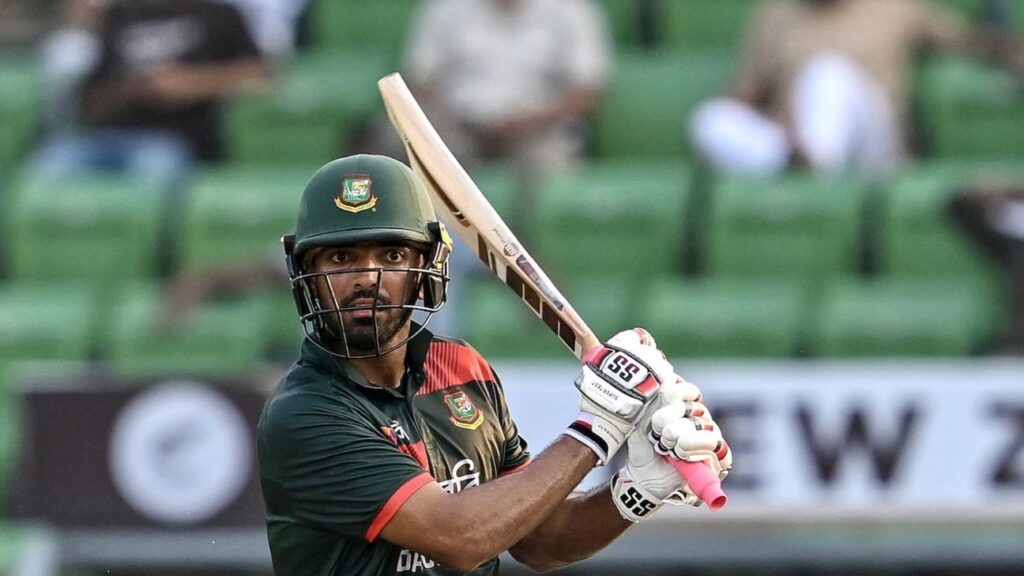
The partnership between Towhid Hridoy and Afif Hossain became the focal point of the match’s failure. Over the course of 13.1 overs, the two batsmen managed to scrape together 52 runs, but the manner in which they scored was alarming. With only a single boundary between them, the pair played a brand of cricket more suited to a Test match than a limited-overs chase.
The Mathematical Cost of Hesitation
- Starting Run Rate: When Hridoy and Afif joined forces in the 28th over, the required run rate was a manageable 5.13.
- Ending Run Rate: By the time Afif was dismissed in the 41st over, the lack of boundary-hitting had pushed the required rate up to a daunting 7.11.
- Individual Contributions: Afif Hossain struggled significantly, scoring 27 off 59 balls, while Hridoy contributed 24 to the partnership.
This lack of urgency transformed a comfortable chase into a desperate scramble, eventually leading to Bangladesh being bowled out for 221 in 48.3 overs, falling short by 26 runs.
Crowd Frustration and the Pressure Cooker
The atmosphere at the Shere Bangla Stadium mirrored the tension on the pitch. As the overs ticked by without a single boundary, the half-filled stadium grew increasingly impatient. The spectators, expecting a proactive approach in a home ODI, responded to the Test-match style of batting with audible boos. This external pressure only heightened the fragility of a middle order that seemed unable to find a way to rotate the strike or pierce the field.
The issues extended beyond just Hridoy and Afif. Captain Mehidy Hasan Miraz continues to struggle with his role as a slow starter, often failing to capitalize on the platform set by the top order. Furthermore, Rishad Hossain, once viewed as a dynamic option, has seen his batting stocks dip significantly over the last two years, leaving the lower-middle order devoid of genuine firepower.
The Root Cause: Domestic Habits vs. International Demands
Following the match, Saif Hassan attempted to address the conditions, noting that the wicket was “a bit uneven” and “challenging right from the start.” While he admitted that a set batsman found it easier than a new one, he conceded that the team needed to adapt better. “In the Pakistan series… they were true wickets. The wicket here was good too… but I think we could have adapted a bit better,” Saif remarked.
However, the problem may be more systemic than just pitch conditions. Coach Phil Simmons has previously pointed out a glaring discrepancy in player development: many of the current middle-order batters function as top-order batters in domestic cricket. This means they are accustomed to playing long, patient innings rather than the high-pressure, aggressive roles required in the middle overs of an ODI.
With Najmul Hossain Shanto also experiencing a dip in form, the scrutiny on Afif and Mehidy has intensified. Unless the Bangladesh middle order can shift their mindset from survival to proactivity, they risk continuing this pattern of squandering promising starts in the pursuit of a victory that should be routine.