

[CRK]
India Secure Unassailable Lead on the Gold Coast
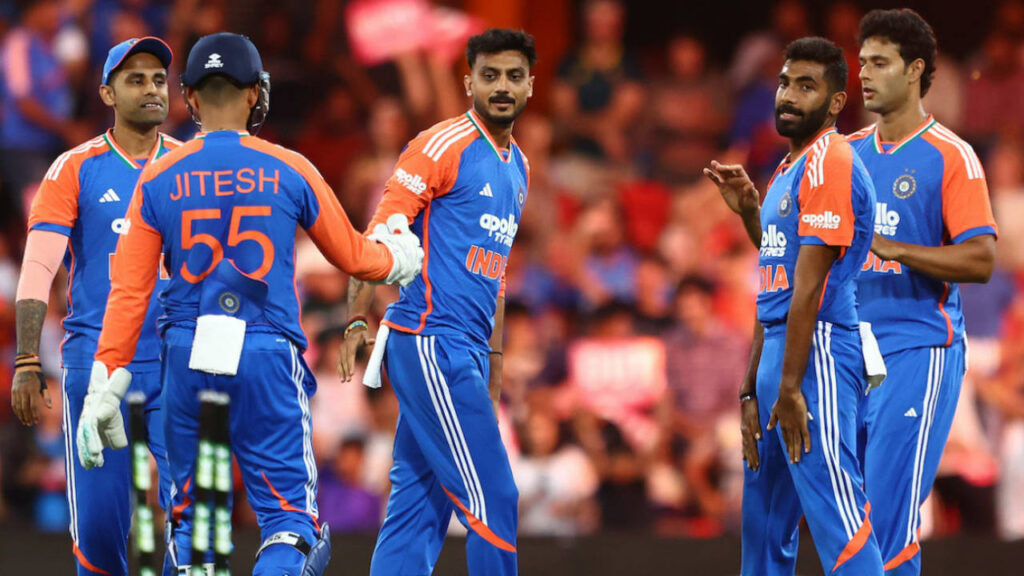
In a match that highlighted the growing potency of India’s versatile bowling attack, the visitors impressively defended a total of 167 to defeat Australia by 48 runs on the Gold Coast. The victory gives India an unassailable 2-1 lead in the T20I series, leaving Australia with only the hope of a shared series in the final encounter at the Gabba this Saturday.
The match was played on a surface that both captains noted had distinct “shades of the subcontinent,” a factor that India exploited to perfection. While the total of 167 for 8 initially seemed slightly light, the Indian bowling unit, led by their spinners and a surprising surge from Shivam Dube, ensured the hosts never found their footing.
The Spin Trap: Axar and Washington Dominate
After having a limited role in the opening matches of the series, Axar Patel emerged as the catalyst for Australia’s downfall. Utilizing sharp angles and a darting trajectory, Patel proved nearly impossible to combat, conceding just 20 runs across his four overs and bowling a staggering 12 dot balls.
Patel’s impact was felt early. Matthew Short, returning to his preferred opening role, had looked dominant until he attempted a sweep and was trapped lbw. A successful review turned the tide, and Axar quickly followed up by deceiving Josh Inglis, who appeared rusty after his time away from the game, as he charged down the pitch only to fall prey to the left-arm spin.
Adding to the carnage was Washington Sundar, whose clinical figures of 3 for 3 underscored the absolute dominance of the Indian slow bowlers. The collective pressure from the spinners triggered a catastrophic collapse, with Australia losing 7 wickets for just 28 runs during a critical phase of the chase.
Shivam Dube: The Unlikely Bowling Hero
While known primarily for his power-hitting, Shivam Dube played a pivotal role with the ball. After a brief exchange with Tim David—where David launched Dube for a massive six that nearly hit the stadium roof—Dube responded with immediate revenge. By banging the ball in short, he hurried David into a pull shot that top-edged into the covers.
Dube’s overall contribution of 2 for 20 provided the crucial breakthroughs India needed to kill off any hope of an Australian recovery. The disciplined approach from the Indian side was further sealed when Varun Chakravarthy dismissed Glenn Maxwell. Maxwell, returning from a broken wrist and lacking match practice since September, completely failed to read a googly on the final delivery of the evening.
India’s Innings: Zampa and Ellis Fight Back
India’s journey to 167 was a rollercoaster of momentum. The innings began explosively, with Abhishek Sharma and the openers putting India in a commanding position at 56 for 0 by the seventh over. However, the return of Adam Zampa proved costly for the visitors. Zampa struck back by dismissing Abhishek Sharma with a googly, ending a blistering start.
Despite a late surge from captain Suryakumar Yadav, who smashed two sixes in one over, Zampa remained a constant threat. He claimed 3 for 45, including the wickets of Tilak Varma and Jitesh Sharma in a tight 17th over. Supporting Zampa was Nathan Ellis, who produced a masterclass in T20 death bowling. Despite a rough start against Shubman Gill, Ellis finished with 3 for 21, using a combination of back-of-the-hand slower balls and wide yorkers to stifle the Indian lower order.
Match Summary & Key Stats
- India: 167/8 (Shubman Gill 46; Nathan Ellis 3-21, Adam Zampa 3-45)
- Australia: 119 (Mitchell Marsh 30; Washington Sundar 3-3, Axar Patel 2-20, Shivam Dube 2-20)
- Result: India won by 48 runs.
T20 World Cup Implications
Beyond the series result, this match serves as a significant warning for Australia. With the upcoming T20 World Cup scheduled for India and Sri Lanka, the dominance of India’s spinners on a slow surface suggests that the hosts will be incredibly difficult to beat on home soil. Australia’s inability to handle high-quality spin and their vulnerability during collapses will be key areas for the coaching staff to address before the tournament.